High Press or Mid-Block: Two Ways to Shape Defensive Space
High press or mid-block? See how starting positions, pressing triggers and space behind the defence shape a team’s choices in a hypothetical match.
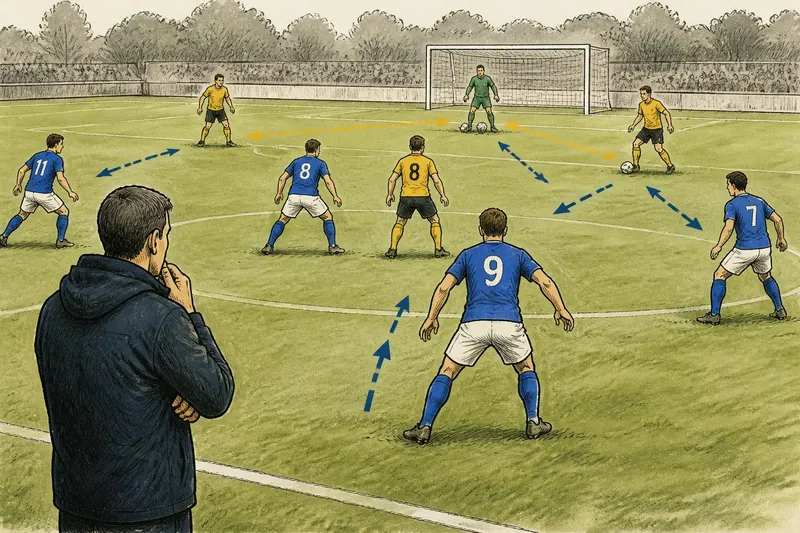
High press or mid-block is a choice about where a football team first tries to control space. Imagine a side protecting a narrow lead against opponents who build from the goalkeeper: its starting line can make the next pass feel crowded, or invite the opposition forward while keeping defenders closer to their own goal.
Neither shape is simply brave or cautious. Each asks players to move together, and each leaves a different area vulnerable. Follow one invented match situation to see how the choice changes the picture, what players need to recognise and when a coach might alter the plan.
What changes when the team starts higher?
In a high press, the defending side begins near the opposition’s build-up area. The centre-forward may approach the goalkeeper while wingers position themselves to close passing lanes to the centre-backs. Midfielders stay close enough to challenge a pass into a central player, and the back line moves up to reduce the room between defence and midfield.
The aim is not for every player to sprint at the ball. A good press uses the first approach to steer play towards a less useful option. For example, a forward might curve a run to block a pass across the pitch and encourage the goalkeeper to play towards one side. Nearby teammates then move as the ball travels, closing the receiver’s options before they can turn.
This can make the opposition’s first passes uncomfortable and place the defending team near goal if it wins possession. The cost is space behind the high back line and in the gaps between pressing players. A well-timed pass over the pressure can send a runner into that space, so defenders need to judge when to step forward and when to protect depth.
What changes when the team waits in a mid-block?
A mid-block begins farther from the opposition’s goal, usually with the forwards and midfielders positioned around the middle area of the pitch. Rather than chasing the goalkeeper’s first pass, the team leaves some room for the opposition’s defenders to carry or circulate the ball, then tries to deny progress into dangerous central areas.
The shape can keep the back line connected to the midfield and reduce the space available between them. Players may allow a pass towards a touchline, where the receiver has fewer directions to escape, then close in together. The team is still pressing, but it chooses its moments from a more compact starting position.
That approach may preserve energy for repeated defensive actions and leave fewer open spaces behind the defence. It also gives the opposition time to advance and choose its next pass. If the midfield line retreats without pressure on the ball, opponents can turn, switch play or deliver into the area from which the defending team hoped to keep them away.
How does the choice play out in one invented match?
Say a fictional team, Northbridge, leads by a goal late in a match against Vale. Vale’s goalkeeper is comfortable passing to either centre-back, while its forwards are quick enough to chase a ball played behind Northbridge’s defence. Northbridge’s coach has a choice: press high and try to disrupt the build-up, or hold a mid-block and protect the route towards goal.
Northbridge starts with a mid-block. Its forwards screen passes into Vale’s central midfielders, while the midfield line stays close to the defenders. Vale’s centre-backs pass between themselves, then carry forward. Northbridge does not rush out individually; it holds the shape until Vale tries a pass towards a full-back near the touchline.
That pass becomes the cue. Northbridge’s winger closes from the inside, the nearest midfielder steps towards the receiver, and the full-back behind them prepares to follow a run. Vale cannot turn cleanly and plays backwards. The team has not won possession, but it has guided play away from the middle and kept its defensive lines connected.
Vale then changes its approach. A midfielder drops towards the centre-backs to draw a Northbridge player forward, while a forward stays high between the centre-backs. Northbridge’s midfielders now face a choice: follow the dropping player and open space behind them, or hold their positions and let Vale build. The coach signals a higher press for the next goal-kick, with the nearest midfielder ready to move only if the dropping player receives with their back to play.
Vale instead finds a direct pass towards its forward. Northbridge’s centre-backs step up together to challenge, while the goalkeeper watches the space behind them. The pass is contested and falls to a Northbridge midfielder, who plays towards the touchline and helps the team move away from immediate danger. In this invented sequence, the mid-block has shaped the first phase; a selective press has responded to a specific cue rather than becoming an all-out chase.
The result is not proof that one arrangement is better. It shows that the starting shape can change during a match, provided players understand what prompts them to move and who protects the space they leave.
Which signs help you read the team’s plan?
- Where the forwards begin: near the opposing centre-backs suggests a high press; farther back suggests a mid-block.
- What the first defender does: a curved approach may close a passing lane, while a direct chase can leave easy options around the ball.
- How the midfield follows: coordinated movement keeps pressure connected; a large gap can let an opponent receive and turn.
- How high the back line stands: a high line supports pressure but offers space behind; a deeper line reduces that space while inviting the opposition closer.
- What triggers the shift: a pass towards the touchline, a backward pass or a poor first touch may prompt several players to close at once.
These signs help separate a deliberate mid-block from a team simply being pushed back. Watch whether players move together and whether their positioning guides the ball towards a chosen area. A shape is a shared pattern, not a fixed row of players.
When does a high press or mid-block fit?
A high press can suit a team whose forwards can close quickly and whose defenders are prepared to cover space behind them. It can also be useful when an opponent repeatedly struggles to play through pressure. If the opposition can evade the first wave or has runners ready to exploit the back line, the same approach may expose the defence.
A mid-block may suit a team that wants to protect the central route and keep its lines compact. It can help defenders avoid being drawn towards the opposition goal, but it needs pressure on the player with the ball. A passive block that retreats without closing passing angles may simply give the opposition room to organise attacks.
It is not worth judging the plan from one high recovery or one pass that breaks through. Look at what the team intended to deny, how its lines moved, and whether it adjusted after the opponent changed its build-up. The most useful reading is often the trigger: which action made the whole shape advance, hold or drop?
What do readers often ask about a high press or mid-block?
Does a high press mean every player runs at the ball?
No. The first player often tries to steer the ball towards a side or block a particular pass. Teammates then close the likely options together rather than all chasing the same player.
Is a mid-block the same as sitting deep?
No. A mid-block is organised around the middle of the pitch, though it can drop deeper as play develops. A deep defensive block starts closer to the defending team’s own goal.
Why does a high defensive line matter during a press?
It keeps the distance between the defence and midfield manageable, making it harder for opponents to receive in the middle. It also leaves more space behind the defenders, which they must manage together.
Can a team switch between the two shapes?
Yes. A team may press on a goal-kick and settle into a mid-block once the opponent escapes the first pressure. The change works best when players share clear cues about when to advance and when to recover.
When you watch the next match, track the starting positions before tracking the tackle. A high press or mid-block becomes easier to understand once you notice which space the team is willing to leave open—and which pass it is trying to make difficult.