How the Advantage Rule Works in Football
Understand the football advantage rule, read the referee’s signal and see when play continues or returns to the original foul.
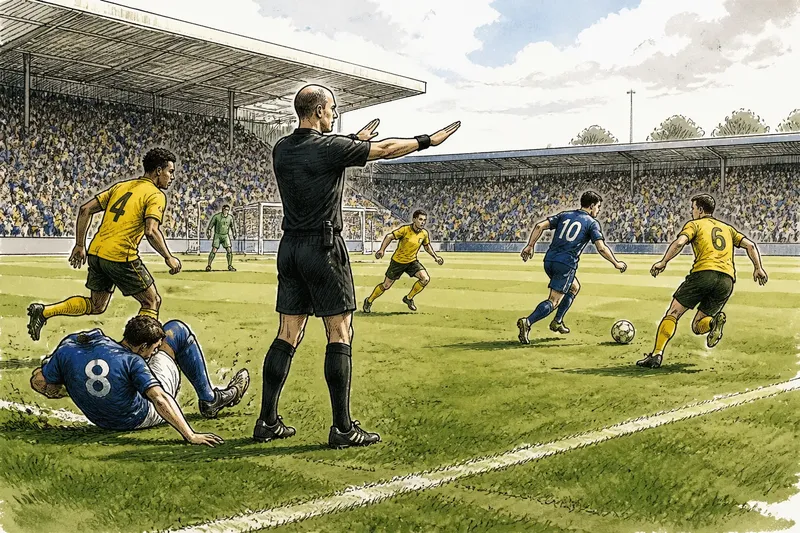
The football advantage rule lets a referee allow play to continue after a foul when the team that was fouled has a better opportunity than a free kick would offer. Watch the referee’s signal, then judge whether the attack actually develops.
Advantage does not erase the offence. If the expected benefit disappears quickly, the referee can stop play and award a free kick at the original spot. The referee is comparing the likely restart with what the team can do while the ball remains in play.
What does the referee’s advantage signal look like?
A referee commonly extends one or both arms forward to show that play is continuing after an offence. Some also call out “advantage”. Signals can vary, so watch whether the referee has stopped play and what happens next rather than relying on one gesture alone.
Do not confuse advantage with a decision that no foul occurred. The referee may have seen the infringement and chosen not to whistle because the non-offending team still has a useful opportunity. A later whistle can refer back to that first offence rather than indicate a new one.
How can you tell whether the team has benefited?
Follow the team that was fouled and assess its options, not just who has possession. A teammate might collect the ball in a promising position, while the fouled player falls behind. Conversely, a player may keep the ball but be forced away from goal and lose the chance to attack.
- Direction: If the team is moving towards a useful attacking area, expect the referee to give the move time; if it has been pushed away from goal, watch for a possible whistle.
- Control: If a player can choose a deliberate pass, dribble or shot, play has a clearer chance to benefit; if the ball is loose and hard to reach, a free kick may be the better outcome.
- Options: If a viable route forward remains open, follow the attack; if defenders close every route, the continuation may not be useful.
- Pressure: If the player has room to act, the opportunity may be real; if opponents immediately crowd the player out, watch for the referee to call the original foul.
- Position: If the team retains possession in a useful area, play may continue; if it has the ball somewhere that offers little attacking prospect, compare that position with the likely free-kick spot.
- Timing: If the attack develops before possession is lost, the team has had a chance to benefit; if it breaks down almost immediately, the referee may bring play back.
These cues help you read the decision but do not predict every call. The referee has to judge the pressure, distance and available options in the moment. It is not worth treating possession alone, or a single pass after contact, as proof that advantage was played.
What happens if the attack breaks down?
If the opportunity disappears almost immediately, the referee may whistle and award the appropriate free kick where the original offence happened. The referee has judged that the promised benefit did not materialise, so the restart is fairer than leaving the team with a poor outcome.
Say a midfielder is tripped just outside the attacking third. A teammate collects the ball, but defenders close in before the teammate can make a forward pass; the referee signals advantage, then whistles and awards a free kick at the spot of the trip. If the teammate instead sends a forward into a promising attack, play carries on.
A later loss of possession does not usually bring the referee back once the team has had a clear, lasting benefit. Advantage is assessed over a short period, not kept in reserve until the next mistake. If the team launches a sound attack and then gives the ball away, that later error is part of play.
What other decisions can follow advantage?
Some serious offences call for the referee to stop play to deal with a player’s conduct or protect players. Advantage does not mean every infringement is treated alike. In some situations, a caution or other disciplinary action can still follow at the next stoppage; the referee’s decision depends on the offence and the applicable competition rules.
What do readers ask about the football advantage rule?
Does the referee always signal advantage?
The referee may use an arm gesture or a verbal call to show that play is continuing after an offence. Keep watching for whether play stops and where the next decision is given, since the signal can vary.
Can advantage apply if the fouled player loses the ball?
Yes, if a teammate has possession and the team still has a useful opportunity. The referee judges the team’s position as a whole, not only what happens to the player who was fouled.
Why might the referee whistle after signalling advantage?
The expected benefit may have disappeared before the team could use it. The referee can then return to the original offence and award the appropriate restart there.
Can a player be cautioned after advantage is played?
In some situations, the referee can let play continue and deal with a caution or other disciplinary sanction at the next stoppage. The advantage signal does not settle the disciplinary question.
How can you read a possible advantage call?
Keep three details in mind when a possible foul occurs: where it happened, which team kept the ball, and whether that team still had a useful option. Watch for the referee’s signal, give the move a moment to develop, then compare any restart with the original spot.
For instance, imagine a winger is fouled near the touchline and a teammate gathers the ball. The starting situation is possession with defenders close by and little room to turn. The referee signals advantage; the teammate tries a forward pass, but a defender intercepts it almost at once. The observable result is that the attack never opens up, so the referee may stop play and award the free kick where the winger was fouled. If the pass instead reaches a forward in space, the team has gained a useful opportunity and the referee is more likely to let play continue.
The football advantage rule is best read as a brief comparison: would continuing leave the fouled team better off than a stoppage? Watch the signal and the team’s next real option together; that makes a late whistle easier to understand.