Your First Volleyball Match: Follow the Rotation
Follow volleyball rotation at your first match: spot the serving change, track each player’s court position and read how the next rally takes shape.
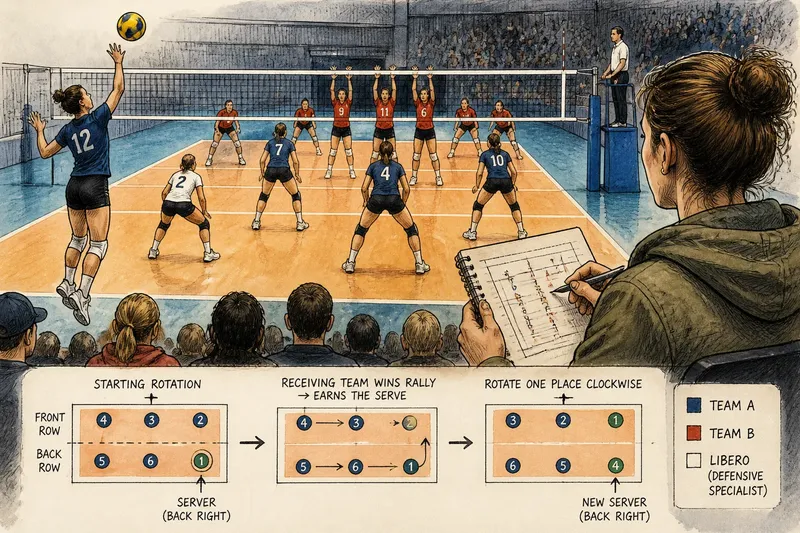
At your first volleyball match, watch what happens after the receiving team wins a rally: it earns the right to serve and rotates one place clockwise. That single change gives you a reliable thread through the match, even when the ball is moving too quickly to follow every touch. Start with the serving change, then notice who moves, who stays near the net and how the team settles into its attack.
What should you look for before the first serve?
Begin by finding the net and the end lines. Each team has six players on court, arranged in two rows of three. The front row plays close to the net; the back row starts farther away. A team’s starting order establishes its rotation, and the players keep that relative order throughout the set.
Look for a team sheet, scoreboard display or coach’s notes showing the starting line-up, if one is visible. You do not need to memorise all six players. Pick out the server and one distinctive detail on each side, such as a shirt number, sleeve colour or playing position. The libero is usually recognisable by a contrasting shirt and has a specialist defensive role.
The server starts from behind the end line. The other players must be in their correct rotational order when the serve is struck, though they can move into tactical positions afterwards. Watch the first few seconds after the serve: players often shift quickly, so their eventual locations may not match the places they occupied at the instant of contact.
What does a rotation actually change?
When the receiving team wins the rally, it scores a point and takes over the serve. Before serving, that team rotates one position clockwise: the player at front right moves to back right, the back-right player moves to back centre, and each player advances one place around the court. The player who arrives at back right becomes the next server.
If the serving team wins the rally, it scores and serves again without rotating. This is the distinction worth watching: the right to serve changes hands, not after every point, but when the receiving side wins a rally. A team can score several consecutive points while its order stays put.
Rotation is not a shuffle into whichever position a player prefers. It is a fixed sequence of six places. Once the serve has been struck, players can move to their normal tactical roles, so the front and back rows may soon look quite different from their starting arrangement. The rotation order remains in force beneath those movements.
How can you follow a set without tracking every rally?
Use the first part of the set to establish a simple routine. At each change of service, check which player moves into the serving position. Then watch the team’s first formation after the serve: who approaches the net to attack, who prepares to set, and who covers the back court? You are following a pattern, not trying to identify every touch.
When a team keeps the serve, stay with the same player who served. Note whether the team maintains its shape or changes its starting positions before the next rally. When service changes, shift attention to the new server and watch the clockwise movement. This makes each change a natural reset for your viewing.
If you lose track, do not reconstruct every point. Wait for the next service change, identify the player moving to back right, and resume from there. The live score tells you who won the latest rally; the serving player tells you which team has the serve. Those clues are usually enough to regain the thread.
Say you arrive after the opening points and see a player in a contrasting shirt serving from the back of the court. You need not work out the entire set’s history. Watch whether that player’s team wins the rally; if it does, the same player serves again, and if it loses the rally, the opponents rotate before their next serve. The next service change gives you a fresh point of reference.
Why do players seem to abandon their places?
They are following the rules while moving towards specialised roles. A setter usually tries to reach a position from which they can set the next attack. Hitters move towards a suitable approach lane, while other players prepare to cover the attack or defend the opponents’ return. These movements happen after the serve, which is why a player’s starting place is not always their main job during the rally.
Compare the players’ positions at the instant of service with their positions a moment later. The contrast helps separate rotation from tactics: rotation determines the order in which players serve and occupy the six rotational places; team tactics determine where they move once play begins. A player may start in the back row but move towards the net to set, subject to the rules for that role.
Front-row and back-row status matters. Players who are in the front row may attack or block at the net under the rules; back-row players have restrictions on attacks made from in front of the attack line. You can follow this visually without judging every call: note which players began in the back row, then watch whether they attack from behind or beyond the line.
What should you watch when the libero enters?
The libero is a specialist defensive player who can replace a back-row player under the competition’s rules. Their different shirt makes substitutions easier to spot. Rather than treating every libero entry as a new rotation, keep watching the serving order: the libero’s role is not simply to take over the next place in the clockwise sequence.
Notice when the libero comes on and which player leaves. The change often signals that a team wants a stronger defensive presence in the back court. Watch the next serve reception and defensive rally for the visible effect: does the libero take a pass, cover a tip or help keep a hard-driven ball in play? A single action can make the role clearer than its label.
Substitution rules and libero procedures can vary by competition, so follow the event’s rules or the officials’ signals if a decision depends on them. For ordinary spectating, it is enough to recognise the contrasting shirt and see that a defensive specialist has entered without assuming the team’s rotation order has been reset.
Which rotation questions help a new spectator?
Does a team rotate after every point?
No. The team receiving serve rotates only after it wins the rally and gains the right to serve. If the serving team wins, it scores and serves again from the same rotational order.
Which way do players rotate?
They rotate clockwise by one place when their team gains the serve from the opposition. The player moving into the back-right position serves next.
Can players move as soon as the serve is struck?
Yes. After the serve is struck, players can move towards their tactical roles. Their rotation order still matters, even if they quickly leave the positions they occupied at service.
Why is the server not always the same player?
The server changes when the receiving team wins a rally and rotates. Each player takes a turn at the serving position as the team progresses through its six-place order.
How can you read the next rally from the rotation?
Use the rotation to make a small prediction, then check it against what happens. If a team has just taken the serve, look at its front-row players and ask who seems ready to attack. Then look for a setter moving into a useful position and a back-row player preparing to cover. You are not forecasting the score; you are noticing how the team turns a fixed order into a workable formation.
After the serve, follow the ball only as far as you can. If you lose it during a fast exchange, watch the players’ reactions: a successful attack often produces a defensive scramble, while a controlled pass may give the setter time to organise the next contact. Then return to the rotation at the next service change. That cycle keeps the match readable without demanding constant, perfect attention.
What is not worth the effort at first is memorising every player’s position, the full substitution history and each tactical variation at once. Those details become easier to notice after the rotation feels familiar. For now, track the server, the clockwise movement when service changes, and the way players spread into their roles.
Keep using volleyball rotation as your reference point through the set: identify who serves, watch for the receiving team’s clockwise shift when it wins the rally, then see how both sides organise after contact. Once that sequence feels natural, the rallies start to reveal more than the ball’s path: you can see how a team’s order shapes its next attack and defence.